Pedalboard Essentials – The Core 3 (or 5) Effects Every Guitarist Actually Needs
The title might sound a bit confusing at first. Three pedals… or five? Which is it? The truth is, it’s not that black-and-white, and you’ll soon see why.
Here’s the thing with pedals: they’re like tattoos. You buy your first one, your brain explodes with dopamine, and suddenly you “need” seventeen more. It happens to all of us. But at some point you have to chill out with the endless cables, power supplies, signal-chain puzzles, and that annoying buzz that appears out of nowhere. Don’t get me wrong – building a mad-scientist pedalboard is incredibly fun. But for the beginning? You really don’t need all that. If you want it later in your musical journey, you’ll get it when the time is right. For now, let’s stick to the absolute essentials.
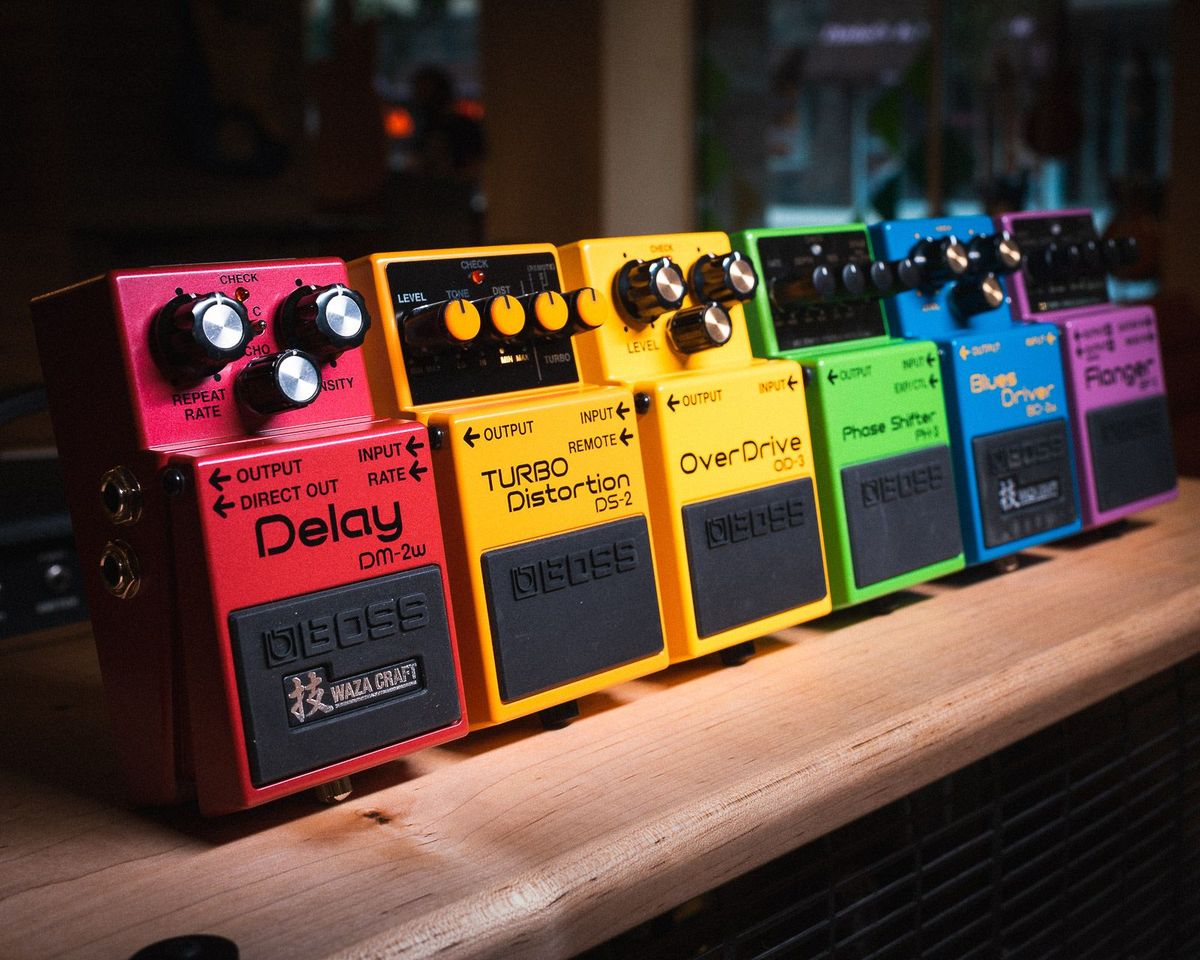
The reason the title says “3 or 5” is simple: there are three categories of effects that truly transform your sound. Some players stop at one pedal from each category (that’s your core 3). Others like to have a couple of options inside those categories (that brings us to 5). I’m not talking about tuners or loopers here – those are useful, but they’re not sound-shaping effects. We’re talking about pedals that make you sound like YOU, only better (and louder).
I’ve split them into three slightly weird (but memorable) groups of my own:
1. Pedals that totally change the energy
2. Pedals that mess with time and space
3. Pedals that duplicate the energy
Let’s dive in.
1. Pedals That Totally Change the Energy
(Overdrive & Distortion)
These are the most fundamental pedals on the planet. They take the clean signal coming out of your guitar and turn it into something that makes the hairs on your arms stand up.
Think of your clean guitar signal as a nice, symmetrical, rounded wave. An overdrive pedal gently “squashes” the top and bottom of that wave (a.k.a. soft clipping). The result? That beautiful crunchy, saturated tone we all associate with blues and classic rock ’n’ roll. Turn the Drive/Gain knob from zero to max and you go from “almost clean with attitude” to “on the edge of distortion territory.”
Overdrives are also fantastic clean boosts. Need your solo to cut through the mix like a hot knife through butter? Step on the overdrive (even with low gain) and boom – instant spotlight.
Distortion pedals go further. Instead of gently squashing the wave, they brutally hard-clip it. The waveform becomes squared-off, aggressive, broken – pure sonic violence (in the best way possible). Step on a good distortion pedal while hitting a heavy riff and people in the crowd will make “that face.” You know the one.
My advice for beginners: if you can only pick one from this category, get a good distortion pedal. You can always add a separate overdrive or a low-gain “transparent” overdrive later.
2. Pedals That Mess With Time and Space
(Delay & Reverb)
Yes, it sounds like we’re in a sci-fi movie. And honestly, the first time you use these properly, you’ll feel like you are.
Delay is the “time” pedal. It records what you play and spits it back at you after a certain amount of time. You control how many repeats, how fast they come, and how loud they are. It’s basically a controllable echo. But what it does to your guitar tone always blows me away. With this pedal, notes last much longer – actually, as long as you want. Just don’t overdo it. Also, some pedals have the ability to combine delay with other effects, or even make the tone sound like it’s going backward. Simply, it changes the duration of the note.
Reverb is the “space” pedal. It simulates the natural reflections of sound in different environments. This pedal is a portal that sends you from dimension to dimension and turns one space into another. Imagine you can go from a cathedral to a cave, or a concert hall, in a second. Well, that’s what this pedal can do. It imitates the background sound for you.
In real life we hear reverb everywhere, but our brain usually filters it out. A reverb pedal slams that ambience right into your face (in a good way). Nothing makes a clean chord progression sound more epic than a wash of beautiful reverb.
Rule of thumb: use both subtly at first. Too much delay = muddy mess. Too much reverb = you disappear in a cloudy soup.
3. Pedals That Duplicate the Energy
(Chorus, Flanger, Phaser…)
Somehow it’s easier for me to describe different groups of pedals this way. And this group is responsible for duplicating the signal coming out of your guitar into two signals and making them different. This includes chorus and flanger pedals.
For starters, I’d recommend the chorus effect. Flanger does some other interesting things and can really be used nicely, but the chorus pedal is somehow more necessary. And what this pedal does is really well thought out. It duplicates the signal into two parts and makes the second part sound very slightly out of tune. That way, you get a fuller, stronger, more pronounced sound – a sound you’ve surely heard on many rock ‘n’ roll tracks. Especially in ’80s music. It can be used really well, especially during choruses. I mean, the name says it all.
How this effect will sound in your hands depends entirely on you. What you can usually adjust on this pedal is the speed of the wobbling of the duplicated signal and the intensity of that signal. Like with all pedals, you can overdo the settings here too, so in some moments the effect will sound like tremolo or vibrato. But don’t do that, because this pedal has its specific purpose.
So… Is That Really All?
Yep. Seriously.
If you have:
• A good distortion (or overdrive + distortion)
• A nice delay
• A lush reverb
• A tasteful chorus
…congratulations – you already sound better than 90 % of guitarists out there.
That’s your core 3–4. If you want the full “starter dream board,” add a separate overdrive/boost and maybe a second flavor of delay or reverb. Boom – five pedals, endless tones.
You don’t need a wah, volume pedal, tremolo, octave, chaotic modulated delays, or any of that stuff yet. Many legendary players have gigged their entire careers with fewer pedals than this.
Final Thoughts
I’ve included demo videos so you can actually hear what each effect does, pedals that nail these sounds.
Now it’s up to you: go try them in a store, watch more demos, read reviews, and figure out which ones speak to your soul and your wallet.
You could, of course, just buy a multi-effects unit that has everything (and more). They’re practical and sound great these days. But there’s something undeniably cool about having real individual pedals laid out in front of you, tweaking real knobs, and seeing those little lights blink when you kick them on.
For me? Analog pedals forever. Now go build your board – and keep it simple (at least for now).