String Gauges Demystified – How Thickness Affects Tone & Playability
Thinking about experimenting with new string gauges? Maybe you’ve found some songs you want to nail, but they’re in a different tuning, and your current strings feel too loose in lower tunings. Or perhaps you’re considering thicker strings but aren’t sure if it’s the right move, so you’re asking around. Or maybe your fingers are tired of wrestling with heavy strings, and you’re craving something lighter. Whatever the case, you’re in the right place.
I won’t claim this post contains everything you need to know about string gauges—that’d be a bit too bold of me. Who am I to limit your knowledge? Rhetorical question. Instead, I’ll give you the basics, explain how strings work in different tunings and genres, and share some subjective insights. By the end of this, you’ll likely have a better idea of which string gauge suits you. I won’t impart all the world’s string wisdom, but I’ll share how I think about this topic, and hopefully, it’ll help you out. Enjoy.
First Things First
So, what’s a string gauge? Simply put, it’s the thickness of the string, measured in thousandths of an inch. You’ve probably heard phrases like, “Hey, I use tens,” or “My fingers are too strong for nines, so I play thirteens,” or “I started with eights, but now I’m on elevens.” These numbers refer to the thickness of the thinnest string in the set, measured in thousandths of an inch. So, when someone says “tens,” “eights,” or “twelves,” they’re talking about the thinnest string, like 0.010 inches. Of course, nobody’s out here casually saying “zero-point-zero-one-zero inches.” We’re not scientists.
If string sets are named after the thinnest string, how are the other strings in the pack labeled? That depends on the manufacturer and the intended use. Here’s a rough breakdown of common gauges:
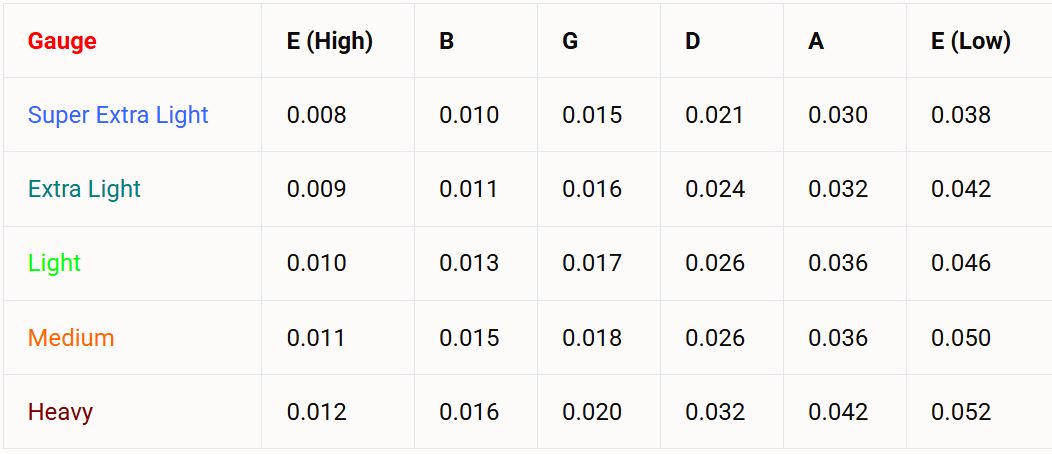
Different brands mix and match gauges within sets. For example, some “tens” sets might have a thicker low E string, like 0.050 instead of 0.046. This allows you to drop-tune the low E without losing stability. There are countless combinations out there, so it’s about finding what works for you. And to do that, you’ll need to experiment.
What Do You Get with Different Gauges?
As you’d expect, lighter (thinner) strings—like eights or nines—produce a brighter, snappier tone with less sustain. They’re great for fast playing since they don’t require much pressure or finger strength to get the desired sound. They’re especially beginner-friendly; as you build finger strength, you can move to heavier gauges. Imagine a beginner starting with twelves—chances are, they’d give up on guitar pretty quickly.
Lighter strings are much easier to bend and great for vibrato techniques. However, if your guitar isn’t properly set up for them, you might get fret buzz in certain positions. Also, the genre matters—thinner strings don’t deliver much low-end. They emphasize treble and thin mids. They can handle tunings like F standard, but I wouldn’t recommend going below D# standard. Any lower, and they’ll start to feel too floppy and lose their purpose.
Thicker strings—like elevens, twelves, or heavier—work differently. They’re harder to bend and require more finger strength to get the tone you want, though this also depends on your tuning. They produce a deeper, warmer tone, often without unwanted fret buzz. Their sustain tends to last longer than thinner strings. Because of their thickness, they’re ideal for lower tunings below E standard. This keeps the tension comfortable and the sound rich without putting too much strain on the strings.
The downside? Your fingers need time to adjust to the higher tension, and it might take a while to build speed. But if Stevie Ray Vaughan could do it, so can you. You’ll also need to check how your guitar handles thicker strings. Some nuts might have shallow nut slots, causing buzz, or the neck might bow slightly, requiring a truss rod adjustment. Nothing a good setup can’t fix.
The sweet spot, the perfect balance, lies with tens. These are the strings most guitarists use, and for good reason—they offer the best of both worlds. They’re thin enough for a bright tone but thick enough to deliver solid mids and bass. You can shred across the neck or play riffs that make your head bang instinctively. No wonder they’re so popular.
The downside? Tens don’t fare well in super-low tunings, like below D standard. Sure, you can tune them lower, but they’ll feel too loose and flap around. For those experiments, go for gauges thicker than tens. Think of tens as the sweet spot for E standard, D#, or, at the lowest, D standard. Thicker gauges, like elevens, are great for D standard, C#, or C standard, and so on, shifting down a step or two as the gauge increases.
What About Acoustic Guitar Strings?
Things are a bit different here, but the principle is the same as with electric guitar strings: thinner strings are easier to play; thicker ones are harder. However, the classification isn’t identical.
For electrics, eights and nines are considered light, but for acoustics, tens or elevens are light. Twelves might be medium, and anything heavier falls into the heavy category.
With acoustics, you need to be careful about which string gauges you use. Not all acoustic guitars have a truss rod, and body sizes vary. Smaller-bodied acoustics (with smaller soundboxes) work best with light or medium strings, while larger-bodied guitars benefit from thicker strings to bring out their intended sound. Putting heavy strings on a smaller acoustic could warp the neck or even cause it to crack under the tension. If you want to try thicker strings on your acoustic, leave the swap and setup to a professional.
And Classical Guitar Strings?
Classical guitar strings are a different beast. Yes, they come in different thicknesses, but they’re classified by tension rather than diameter. Unlike electric or acoustic strings, the treble strings on classical guitars aren’t always thinner than the bass strings, so the gauges don’t follow a linear progression.
Nylon strings for classical guitars are divided into low, medium, and high tension. Low-tension strings are a beginner’s dream—easier to play, especially on guitars with high action. They’re gentler on your instrument but produce the deepest tone of the three categories. Your guitar will thank you.
High-tension strings are tougher to play, especially on less forgiving guitars. They’re louder but harder to fret and can damage an instrument not designed for them. Medium-tension strings, much like tens for electrics, strike a balance—offering decent volume and playability. They’re a solid starting point, and you can go up or down from there if needed.
Conclusion
If I told you to grab tens for your electric, elevens for your acoustic, or high-tension strings for your classical guitar because they’re “the best,” I’d be lying. No one can tell you which string gauge are perfect for you. Even if someone claims to know, it’s just their personal take. All I can do is give you the basics and explain what’s going on. You’ll need to experiment and feel it out for yourself—on your fingers and in your ears. If you’re unsure where to start, try recording yourself with different gauges and compare the sound. Who knows? It might just point you in the right direction. Enjoy.